
Catching Up on Whiteness
Previously on this blog, we've discussed the illusion of white Americans being "cultureless" or without ethnicity. To quickly summarize: There is no such culture as "white culture" because "white" is not identification with an ethnic or cultural background, but with a place in a caste hierarchy. White people often express feeling that they have "no culture" when in reality there is a dominant heavily Germanic-influenced EuroAmerican diasporic gestalt culture, which is so normalized as the default in North American that we regard it as boring or lacking in ethnicity. Quintessentially Germanic cultural foods, preferences, and beliefs are perceived as absence itself—partly due to cultural preferences towards simplicity and pragmatism found in Germany, the Netherlands, England, Sweden, etc.
"Ethnic" is a word we apply to people of color, or Europeans who have failed to fully assimilate into Whiteness. Often on paperwork, your "ethnicity" is exclusively whether or not you are Latin American in some manner. We do not think of European-Americans as being "European-Americans" or having any culture, ethnicity, or traditions. We do not see hot dogs and hamburgers as German-American, but as the default prototypical food of America. Nothing is white, it is simply default, and in being default, it becomes the prototype of being perceived as a person.
Assimilation into "Whiteness" is requisite to fully claim the privilege of one's status as white in the caste hierarchy. Your actual skin tone and facial features are only a part of it. To become white, Italian-Americans must stop speaking Italian, Jewish-Americans must stop dancing to Klezmer, Irish-Americans must "simmer down," and Slavic-Americans must stop wearing Rushnyk. These things are old-fashioned. They are for old people. They are ethnic. They are of the old world. They make you stand out. You don't want to be Belarusian or Greek or Serbian. You don't even want to be Dutch, Swedish, or Irish. You want to be vaguely ambiguously German or English or French but really who can say. Our grandparents took this deal with the white devil, assimilated, and a few generations later white people emerged with no sense of cultural identity, they might not even know where they came from, and to fill the hole left behind, they seek to appropriate culture from the people of color who are still marked as "ethnic." Most commonly, this means taking culture from the African diaspora. (There is also a whole long history of colonialism and cultural appropriation but that is outside the scope of this essay.)
White People Can't Dance
Now that we've caught up, what we are discussing today? Dancing. White people can't dance and don't dance. This is the stereotype. White people have no rhythm, are bad at dancing, and go to live music concerts and just stand there doing nothing except maybe nodding their heads a little. This stereotype is of course, a stereotype, it does not apply to all white people, but go to a funk concert at West Philly Porch Fest and count how many white people are just standing around and not dancing. It's abysmal. Ask a white person at said concert to dance, and what will they say? "I don't dance." "I don't know how to dance." "I have two left feet." "I have no rhythm." Oddly enough, it's an internalized and self-reinforced stereotype. Usually white people are smugly assuming they're better at everything than any other group of people, but not with dancing. They might disparage the dancing of people of color as being vulgar... but they don't have anything else to offer in return. Even if they point to Waltz, they rarely know how to Waltz themselves.
The more assimilated someone is into the white monolith, the less likely they are to know how to dance. Why? I believe that this lack of dance among the white-ified population is in fact a by-product of their assimilation into Whiteness, because it's white people who can't dance. Europe is not devoid of dance. It's even a comedic stereotype of Europeans that they love to dance. It's American "white people" who have lost their ability to dance, like how a domesticated fox might lose control of its bladder. To folk dance is to mark oneself as ethnic, but in assimilating, we have lost dance entirely.
Serbs Can Dance
The almighty algorithm noticed I was watching videos of people Lindy Hopping, and started serving me videos by Ed People. Ed is a Belgian dancer who travels around the world and asks people to teach him their favorite dance move. Of course everyone he asks turns out to be a great dancer who knows some traditional dance, so I am sure it is highly edited and somewhat staged, but it is still a delightful thing to watch. His video on Serbian dances appears to show crowds of people everywhere in the city running over to join hands whenever they see someone dancing the Kolo. It is apparently a traditional folk dance so well-known and popular that strangers will drop what they are doing to join in.
In the comments, I saw Americans, praising this simple folk dance, saying how happy it made them to see people of all stripes dancing together in Serbia. There is a particular genre of comment I saw a lot of: "Serbia, please never lose your tradition." "Serbia, it is so wonderful that you still know this dance, and I hope you never forget it." White-ified Americans see Europeans who know how to dance together and feel a pang of loss.
Here in America, dance is seen as challenging, sexy, intimidating. There is a sense of potential humiliation deserving of fear. Americans I speak to who do attempt to dance, or to learn to dance, frequently express to me the same emotion: they feel horrible and embarrassed because they aren't immediately good at something they've never done in their entire life. It's not private. It's something everyone can see you be bad at. It is not sexy to be new at dancing. It is not sexy to be Jon Arbuckle dancing alone.
But the Serbian children teaching Ed People to do the Kolo are not trying to be sexy. The purpose of dance is not to impress people. The purpose of dance is not to look sexy. The purpose of dance is to have fun and connect with other people.
Social Dancing
Recently, I hit a new brain injury recovery milestone: I can enjoy live music and dancing again—holy fuck yes! I have not written about this much online but I grew up a music person. I did musical theater for ten years. I sang in a multicultural college chorus. I went to Shapenote singing events. I have been classically voice trained. I used to Contra Dance every week for years. I learned to Blues, Bachata, Waltz, and more. I love social dancing.
So to celebrate my new recovery milestone, I went out to a Contra Dance for the first time in eight years. After graduate school, a pandemic, and a brain injury, finally I was dancing again. It felt so good. I haven't been this happy in years. I love music and dancing.
I am very strongly identified with my Ashkenazi Jewish heritage, but what comes up far less often is my Irish heritage. To me, it was always a source of being bullied by other Jews, and not something I experienced as particularly culturally marked. Other Irish-Americans do tend to look a lot like my dad or uncles, but the familiarity doesn't extend to much else in common. Growing up, there were no Irish flags, no Irish dances, no Irish cultural events or cultural centers. The Irish diaspora in Boston experienced itself as a default type of human. It was the most common heritage among white people and being Irish just meant being white. Perhaps a shorter, more talkative white person who makes jokes about potatoes. That was about it.
To my surprise, the venue for Philadelphia's weekly Contra Dances is the Commodore Barry Club A.K.A "The Irish Center." Strewn about the entire building were Irish flags, harps, shamrocks, and everything else Irish. I'd never been in such a proudly Irish place before that wasn't just a pub with a gimmick for tourists. It felt truly like a diasporic cultural center. I texted my Irish friend, who properly lives in Ireland, that for the first time I actually felt like as an Irish-American I was somewhere connected to that little island we're both from. He said he was surprised that buildings like this weren't common in America given all the Irish-Americans. After all, a building like this would be common in Ireland. He also confirmed that they had not accidentally put up the flag of Côte d'Ivoire, which is common at so-called Irish Pubs.
Not everyone present was Irish. It was mostly white people, but it was racially diverse with a main community leader being Black, and it was all ages, and there were many queer and trans people.
While Contra itself is English, Fresh, and Scottish, the music the band played was predominantly Irish folk tunes. I'm not new to Contra at all, but I was never too aware of whiteness when I lived in Western Massachusetts. It was still very much the default in my mind. In Philadelphia, Black is the default, and being back at a Contra Dance made me see it differently.
Holy shit, this is a room of white people dancing. At Porchfest, I struggled to get any of my white friends to dance with me, and the ones who agreed to try needed to be taught. My friends who actually danced were a less-assimilated Greco-Cyprian friend and a Filipina friend. But dance is not entirely lost among the white-ified population. At the Irish Center, they're dancing. In fact, at the Irish Center, people were not just identifying with the caste called "white." They were Irish, Polish, Scottish, Filipino, Spanish, AfroAmerican, Korean, Jewish, English, Italian, and so forth. Why? Because each one of these cultures has their own music and dance to share in that they were proud to show or discuss. As F. D. Signifier desires, they were becoming less white. They were filling the white void with a culture not appropriated from the African diaspora.
Contra Dancing: From Colonial Import, to Racist Project, to Gay Hippie Polyamory
Contra Dance is an interesting American folk tradition. It started as English Country Dance, a form of English folk dance, which was imported to France where they borrowed the phrase "country dance" into French as "Contredanse." The French added their spin on it, and "Contredanse" made its way back to Great Britain where it then met and mixed with Scottish Country Dance. All three dances made their way to New England and Northern Appalachia where they became very popular, mixed together and evolved into a specific form of dance that came to be known as "Contra Dances." In the years since, Irish folk music and Bluegrass have become the most popular genres to Contra to, and the dance form and culture have continued to evolve with the community.
Contra is danced in long lines. Once gendered, these days most Contras use the terms Larks and Robins for the two dance roles. In a rapid chaotic flurry, dancers find someone to pair up with, generally the first person they make eye contact with who isn't already paired up, and then get in line. Generally, two couples at a time will dance together as a group of four, and then progress down the line such that every couple will eventually dance with every other couple in the line. Like Square Dance, a caller announces what dance moves to do and who to do it with: your partner, your opposite-role neighbor, or your same-role neighbor. Sometimes you might even dance with your "shadow," your next neighbor down the line who you haven't gotten to yet. Most choreography is such that you will dance with both members of the other couple 1-on-1, as well as your partner, before you move on. Every single person in the line will dance with every other person in the line.
Contra has no footwork, which makes it very accessible to the young and elderly. You can learn it in minutes, and events are highly intergenerational. You still need rhythm, as you need to know how long to do each dance move and when to move on to the next, but it's not as challenging as Lindy Hop where you might spend weeks just practicing the six-count basic step.
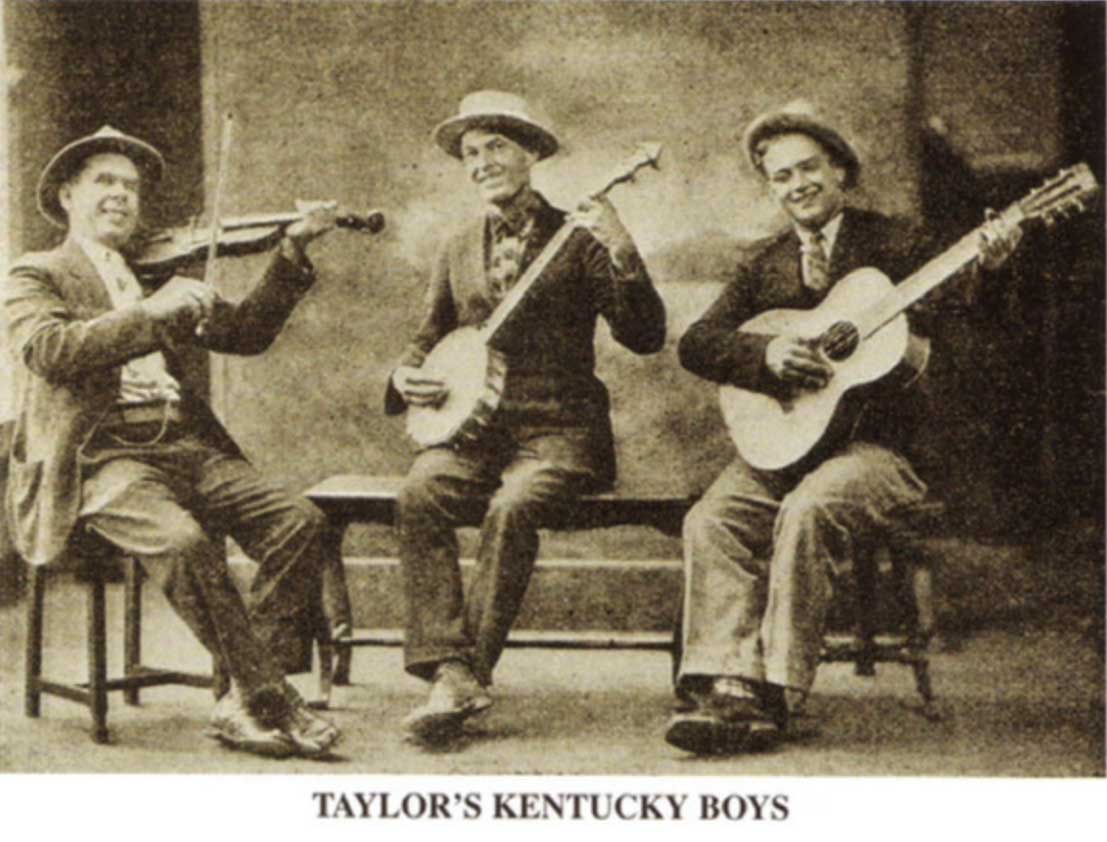
At the turn of the 20th century, Contra began to wane in popularity as African diaspora dances such as the Cakewalk, Tap, Blues, Charleston, Break-Away, and Lindy Hop became popular among both Black and white people. These dances were often paired 1-on-1, and were, of course, seen as vulgar by white aristocrats such as Henry Ford, as in Ford Motor Company. Contra had not died, but it had become something rare to find outside of Western New England and Appalachia. Essentially, you only danced Contra if your rural town was too white to have Jazz available.
Henry Ford used his immense wealth to attempt to fund a Contra and Square renaissance, to get white people off of Jazz dancing and doing more "wholesome" dances with no hip swinging and certainly no close embrace. Ford published a book called Good Morning: After a Sleep of Twenty-Five Years, Old-Fashioned Dancing Is Being Revived which is pretty presumptuous but I guess you can name a book whatever you want. Many states proclaimed Square Dance to be their "state dance." Organizations such as Pinewoods Camp and the New England Folk Festival began to emerge in the next couple decades, but Contra still was a niche thing mostly popular among elderly people in New England. It did not overtake Jazz. The music and dance that would supplant Jazz was also African diaspora music. Ford's racist project failed, in fact, it backfired tremendously.
In the 1970s, hippies came to New England to farm, start liberal arts colleges, smoke weed, have gay sex, play frisbee, and folk dance. Contra involves lots of twirling, so men started wearing kilts so they could enjoy the twirling too. Kilts are Scottish and Contra is part-Scottish so that felt natural. Then the men started wearing colorful hand-dyed skirts which were even prettier when twirled. Then the women started dancing the Gents roles to balance the line, and oh that's fun, so then they started doing it when they didn't need to balance the line. It's a dance where everyone dances with everyone, so gay people were attracted to it. Soon there were lavender dances in Jamaica Plain, the Village, and eventually San Francisco and Seattle. New England and the Northeast would become the most liberal places in the country, and so the Contra community became a community of elderly white progressive liberal hippies dancing in colorful gender-bending clothes with their non-binary grandchildren. "Contraspawn," the children of Contra dancers, disproportionately grew up to be gender fluid and trans, and introduced hip new flourishes and event set contra dances to techno music (which is of the African diaspora, let's be clear. I'm not claiming Contra is completely uninfluenced by other cultures in North America. I don't think "cultural purity" is a desirable thing.)
Contra spread around the country and, long after Ford's death, truly had a renaissance, not as a conservative alternative to Jazz, but as a gay liberal polyamorous form of social dancing (did I mention a lot of Contra people are poly, unsurprising given the dance) where people cross-dressed and traded protest songs. Eventually, they would come to abolish gender entirely, with the 2010s marking the "Contra Gender Wars" and a decade-long mission to find new dance role terminology everyone could approve of. Larks and Robins won out, and young contra dancers think it must have been a centuries old tradition to be birds instead of genders.
The Folk Song and Dance Community
Contra is the most popular traditional European social folk dance, but the community around it has embraced a celebration of traditional folk song and dance from a range of cultures. At events like Flurry, NEFFA, and Pinewoods Camp you'll learn to Polka, Folk Waltz, Morris, Hambo, Hora, Zydeco, Step Dance, English Country Dance, Scottish Country Dance, Ceilidh, and possibly even those once-called "vulgar" dances from the African and Latin diasporas like Lindy, Blues, Salsa, Tango, Hip Hop, and Samba. You might even learn some dances that probably shouldn't be getting taught by white people, because white hippies still love cultural appropriation even when they do have their own culture present.
You'll sing old folk songs in a range of languages and cultural backgrounds, from old labor hymns to Shapenote, Blues, Slavic folk, and Yiddish. They just love music, dancing, and folk culture.
"Volkish" has a concerning connotation historically, but in America, these communities are strongly on the left-liberal side of the aisle. They love diversity so much. What folk provides them is a sense of heritage not tied into their place in a power structure. These people comfortably identify as Irish, Scottish, Swedish etc. and do-so in a way they feel good about independent of how that group wields power over others. There is no sense of superiority that I have ever perceived. They are not snobbish towards African diaspora dances and will be happy to learn those too if you're willing to share. Many Contra dancers are also Blues and Swing dancers and at least in Philadelphia, you are literally not even allowed to Lindy Hop past a certain level if you don't learn and respect the history of Jazz as a Black invention. (Newer African diaspora dances from after the 1920s are, I think, probably not yet old enough to be seen as "folk.")
White supremacists tout the "superiority" of "white" European culture, and position their relationship to these European upper-class aristocratic art forms as being about their supposed superiority and power. They identify with Greek statues, Mozart, and Waltz only as a way to identify with power.
The folk community is not doing this. The folk community is preserving and celebrating the working-class folk traditions. The dances that were done by farmers in barns and ordinary people at weddings. Social dances are not performances in a ballroom to show how stately and elegant you are. At a social dance, nobody can even see you dancing, because they are busy dancing themselves! Social dancers are constantly smiling and laughing at mistakes, and will ask anyone to dance.
Folk traditions are too old to be under copyright. Nobody owns Contra. Folk traditions are free. We can klezmer dance in the park and it costs nothing and requires no permission. People love to share their own culture's folk dance, and it only really crosses the line from cultural exchange to problematic cultural appropriation when people start profiting off of it. Folk dance is simply pure joy and community with no real consumerism attached besides a cover charge to pay the band and venue. Usually $10-20 at most. Cheap.
De-Assimilation through Folk
The Philadelphia Yiddish Revival Movement
 Peter Crimmins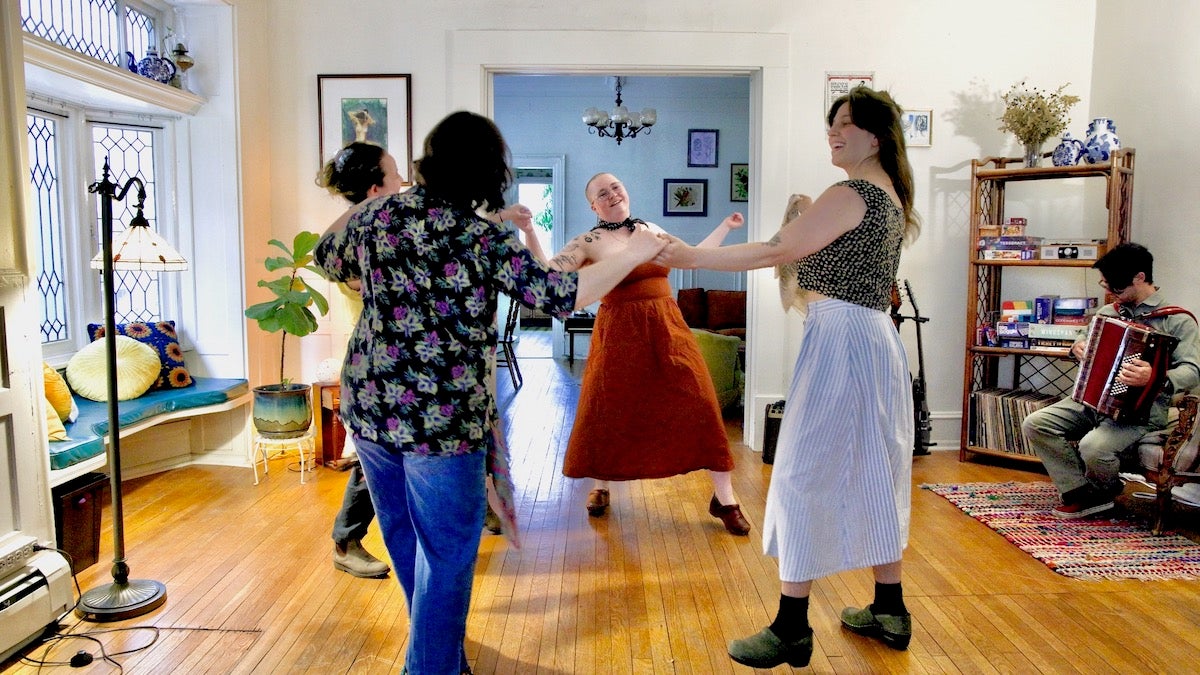
Young adults in Philadelphia are reviving Yiddish culture. There are monthly Klezmer jams, Yiddish conversation circles, Yiddishist unconferences lead out of houses, and of course Klezmer dance workshops. Why?
Quote Jack Braunstein to WHYY:
“I think there’s an element that’s about saying ‘no’ to the actions of these illegal settlements, apartheid and what leading human rights groups internationally and in Israel have described to be a genocide,” said Jack Braunstein, a West Philadelphia musician, whose experimental folk music is rooted in Yiddish concepts. “There’s also an element of saying ‘yes’ to something else. You have to have an alternative.”
Yes, Ashkenazi Jews are embracing our old-world language and folk arts as an act of self-distancing from Zionism and Israel. The Zionists rejected diaspora culture, and now we are embracing it. I have also seen Sephardic Jews attempting to revive Ladino and even performing Ladino piyyutim and folk songs from old sheet music that has not been performed in over a century. The other week, at the William Way LGBT Community Center, over a piano, I and a few other yids sang Yiddish songs from socialist Yiddish day-schools which had not been sung in Philadelphia since the 1940s.
The Philadelphia Yiddish Revival Movement is entirely grassroots, receiving no funding from major Jewish institutions. It is entirely self-motivated by a desire to connect with a heritage that is not Zionism or Whiteness. When my Bubbe refused to speak Yiddish around my mother, it was an act of assimilation. The Philadelphia Yiddish Revival Movement is therefore an act of de-assimilation.
What if all white-ified people did the same?
Why should only Jews revive our culture?
Every culture has a folk dance and folk music. What's your heritage? Do you know? No matter where you're from, even if you're a part of a diaspora community whose pre-American roots have been erased, you definitely have a traditional folk dance and associated folk music attached to your heritage, even if that folk dance emerged in diaspora. Folk dances are usually easy to teach and learn, something that everyone in a community can know and dance at any time. Why don't you look into a folk dance from your culture? How about learning to play or sing the music that goes with the dance?
In White Neutrality I was rather pessimistic about white people distancing ourselves from whiteness, but I do think that Folk traditions in this liberal hippie way can offer a path for de-assimilating from whiteness. In Philadelphia, a multi-racial Women and Trans/Non-Binary Slavic Folk Choir performs dressed in rainbow garb. It is a non-supremacist appreciation of culture. It is not saying Slavic folk songs are better, or that they are only for people of Slavic heritage, it is both preservation and celebration.
I was recently invited to learn Bataireach, a traditional Irish martial art whose instructors frame it as a folk practice for resisting British colonialism. There's a lot for Irish-Americans to identify with about being Irish besides potatoes, beer, and white supremacy.
Cultural exchange is actually quite beautiful, and a lot of European folk traditions are quite cool and fun. I think it can be healthy to identify with a European ancestry in a non-superior non-power-oriented way, and something like folk dancing or folk songs offer a way to enjoy something that isn't just your own privilege.
White people don't know how to dance because they lost their folk traditions in assimilation, but those traditions have been kept alive by gay hippies in the woods. Even if you're a WASP, why not learn some Morris or English Country Dance? It's so old, it's precolonial! If you really need to assuage those weird feelings about enjoying something European, you can also go learn some Lindy Hop and tell yourself "yeah Lindy Hop is definitely the superior dance. Black people are still better than me at dancing and that's okay. I will also enjoy my own traditional dances too." I think this is kind of silly and unnecessarily self-flagellating but if that's what it takes to get you all to dance then I'll take it.
Fill the void with something that isn't power. Fill it with joy and community. Learn to Kolo, and then share it with your family members, and with people from other racial and ethnic groups. You maybe can't fully disown your position as white in our racial caste system, but what if you made something else more salient. What if being a EuroAmerican Mutt isn't a matter of impurity and low-status. What if it doesn't mean you have no culture or heritage. What if it means you have four to eight paths to explore to find fun new songs and dances! Four to eight new languages to learn!
Recently, I encountered the song Wild Rover, an Irish folk song.
It sounded incredibly familiar to me, but I had learned it to different words. I listened to the song four times until I realized where I knew it from. I learned it as a Lecha Dodi!
O' Lecha Dodi... bum bum bum bum
Likrat kala
P'nei shabbat p'nei shabbat
O' N'kabalah
I was at a traditional egalitarian Minyan when I learned this melody for Lecha Dodi. A conservative traditional community. The kind that ostracized my mother for marrying an Irish man. Someone, somewhere, had learned this Irish folk melody and not only made it Hebrew, but introduced it to a community that does services 100% in Hebrew. It's not a syncretic hippie space. One of my cultural heritages had met and kissed the other in the office of a Jewish day camp.
Many Jewish folk songs are Slavic folk songs we learned when playing concerts at their parties and took home from us. Cultural mixing and marrying is beautiful, and it's possible to do in ways which are non-supremacist, respectful, and non-capitalist. Let's trade songs and dances. Let's share together in the beautiful diversity of cultures in the world.
Call to Action: Learn to Dance and Become More Ethnic Now!
The Yiddish Revival community in Philadelphia is motivated by seeking heritage and culture outside of Zionism. Building an alternative in solidarity with Palestine. Often these Yiddish folk fests are fundraisers for Palestinian relief, and organized by the same people in Jewish Voice for Peace. They attend progressive non-Zionist synagogues with reparations committees paying into projects to support their Black neighbors. They show up to protests. They seek cross-cultural solidarity while celebrating their own community and heritage too in a non-superior way.
Why should only Jews be doing this? If you research your family history and discover you're Czech, I want you to learn to Polka, and then teach me! And then we'll go protest ICE together. We can Polka at the ICE protest. Instead of being white and declaring your Welsh-Polish-Finnish-German status as something embarrassing or boring, I want you to go learn Welsh dances (I hear they're challenging!), learn to pronounce your Polish surname, learn to sing Kalevala, and learn to Schuhplattler! We make fun of Germans for the Schuhplattler but I bet it's really fun! When someone asks you what you are, say "I'm Welsh, Polish, Finnish, and German! Isn't that exciting! I have so many difficult languages and dances in my heritage!" Use your reconnecting with heritage as a springboard out of seeing yourself as having more in common with white aristocrats than your neighbors of color. The dance and music gives you an alternative to identifying with a position of power.
Participate in cultural exchange, too. Trade dance moves with neighbors of color. Dance is a great way to connect with others. Go to those Porchfest concerts and actually dance with other people. Trust me, you will make new friends.
And regardless of your cultural background, I highly recommend social dancing! It's just really fun! Contra is incredibly accessible and you'll find them everywhere. You won't be the only trans person wearing a KN95 mask. I also love Blues dancing, which is highly improvisational. Lindy Hop is popular across the country and not as hard to learn as it looks (though in Philly, to take the advanced classes you do have to pass a Black history exam, so go read about the Savoy ballroom). I've been told English Country Dance is actually very fun, and Waltz is actually a crazy good time. All the social dancers are nerds who like old music, and you'll find a lot of them are queer and neurodivergent. My carpool home from Blues asked me for my top three anime, and he was really good at Blues dancing. The old people will be hyped to have a new person and excited to teach you. Don't be afraid! Learn to move your body! The rhythm will come to you if you actually try to learn. It's humanity's oldest social activity for a reason.
Dance with me!!
If you're in Greater Philadelphia, come dancing with me! There are tons of social dance events in the area. Any labeled "international folk dance" means it's a grab-bag of dances from many different countries, usually taught by someone from that culture.
Here are some of the ones I frequent. All of these begin with a lesson! You do not need prior knowledge or experience.
Mondays are Powerhouse Blues at 7:30 p.m. at the Philadelphia Ethical Society. This is an African diaspora dance and it has a really interesting history regarding how the dance formed around having to dance in tight spaces like Juke Joints.
2nd and 4th Tuesdays are Park Ave Contra Dances in Swarthmore, PA (off the Media-Wawa regional rail line.) The beginner lesson is at 7:15 p.m. and the dance is at 7:30 p.m.
Every Thursday and Third Saturdays are Mt. Airy Contra Dances in Philadelphia (off the Chestnut Hill West regional rail line.) Times vary. This same group also organizes Contra dances in Center City on most Fourth Saturdays. I haven't made it out to a Center City dance yet because of business trips falling on the fourth weekend a lot, but I hear it's a younger more hip crowd.
There aren't regular Klezmer dances, but Shtetl Philly often hosts workshops among their various Yiddish offerings.
Thursdays also have Jazz Attack which is a Lindy Hop group. Lesson is at 8:00 p.m. and the dance is at 9:00 p.m. Lindy Hop is an Africa diaspora dance that is verging towards becoming a folk dance as more time passes, time will tell on that. It is very fun though. I'm considering cheating on Contra a bit to try out some Jazz Attack.
There are also Ceilidhs in Philly, which is Celtic folk dancing, and I've seen fliers for Irish step dancing. I haven't been to these and have been having trouble figuring out how their scheduling works. They exist? For me the Irish folk music played at Contra dances is my Irish cultural vitamin pill.
Contra is super fun, very accessible, and dirt cheap for a live music concert. Highly recommended for anyone, whatever your background. It's an American folk dance, so it belongs to everyone. It's free culture.