

Over time, I have come to develop a strong sense for who "my people" are. There isn't one single trait they share in common, but there are many traits they often share in common: "Alternative" lifestyles, autism, transgender, left-wing views, and generally being a "weird nerd" in a good way. There are numerous niche hobby communities where you can find "my people," but they aren't in every niche hobby community, nor do they necessarily dominate every space you can find them in. When you hear which niche hobbies they're into, you are never surprised. Everyone who likes this also likes that. At the very least, they are "the kind of person who would like that."
There is a dispersed web of people who are "us" and I feel familiar with them. I do not necessarily like all "my people," they might not even be good people, but still we are birds of a feather. There are millions of us, and yet we overlap in such a way that we all seem to be within a few degrees of each other socially. The furry pro-gamer somehow is connected to the witchy tattoo artist living in the woods. The folk musician somehow is connected to the hacker. The circus performer somehow is connected to the rabbinical student. These things sound unrelated, but if you're like me, your reaction to this is simply: "Of course they are."
Being "my people" isn't the same as being my friend. My friends are almost without exception "my people," but plenty of "my people" are not people I would want to be friends with. When I meet someone who is one of "my people," whether or not I like them or want to talk to them, they feel familiar to me. We have shared touch-points and values. Conversations feel more natural and unmasked than with "normies." Even the ones I don't like, I "get what their deal is." They may be uniquely strange to everyone else, but not to me. I know them even when I don't know them. It's not about liking each other, but what "kind" of person they are.
To put it briefly: we are of a tribe.
There is another tribe of weird Autistic nerds.
Meet the Rats
Tor Parsons is an Autistic YouTuber who you may have seen before. He makes medium-long video essays info-dumping about miscellaneous niche things. It's the kind of channel enjoyed by the sort of person who sees something they have never heard of and thinks "I don't know a single thing about that or why I should care about it. Obviously, I need to learn more." Unsurprisingly, many of "my people" (including myself) love this channel. I can't count the number of times in a conversation someone began to explain the Mormon Alphabet and they were interrupted with: "I also saw that episode of Tor's Cabinet of Curiosities."
Tor shocked everyone last year when he revealed that he is a "Post-Rat." He begins his hour-long explainer on the subject with a sort-of "coming out" as a member of the Rationalist subculture. He is immediately defensive of his association. After all, only eight months prior to Tor's video, a sect of transgender Rationalists had murdered US border patrol agent David Christopher Maland. This triggered a media frenzy asking: What are Zizzians? Who are the Rationalists? Are they left-wing? Are they right-wing? Why did they kill a border patrol agent? Is that based or is it based? Do we like these people or should we disassociate ourselves from them? This is likely what inspired Tor to make his explainer: to counteract the stigma associated with his community.
If you have the time to watch Tor's video, I do recommend it. I'm going to be very critical of the Rationalists in this essay, and I think it is only fair that you first be introduced to their ideas by one of their own people. Notable to me is that the graphics in this video were created by gay Conservative YouTuber J. J. McCullough, while much of the video professes support for left-wing projects such as Trans Rights and High Speed Rail.
If you don't have time to watch Tor's video and have never encountered the term "Rationalist" before, then I'll succinctly define the Rationalists as a subculture of weird Autistic nerds who follow the teachings of Eliezer Yudkowsky, post on the forum LessWrong, care a lot about AI (positively or negatively), care a lot about unlearning cognitive biases so they can be more rational thinkers, and value analytic intelligence above all else. There's of course more to it than that—to describe them comprehensively would be as unending as trying to describe everyone in our lefty-autistic-nerd tribe and what we have in common. That's why there's a multi-hour long video essay about them four paragraphs up.
I want to highlight a moment from Tor's video when he discusses the "Blue Tribe-Grey Tribe Split." This is a reference to a 2014 blog post by Scott Alexander discussing the social and political segregation of America. It's very long, as all good blog posts should be, so here is a long excerpt.
[I]n the same way “going to synagogue” is merely the iceberg-tip of a Jewish tribe with many distinguishing characteristics, so “voting Republican” or “identifying as conservative” or “believing in creationism” is the iceberg-tip of a conservative tribe with many distinguishing characteristics.
A disproportionate number of my friends are Jewish, because I meet them at psychiatry conferences or something – we self-segregate not based on explicit religion but on implicit tribal characteristics. So in the same way, political tribes self-segregate to an impressive extent – a 1/10^45 extent, I will never tire of hammering in – based on their implicit tribal characteristics.
The people who are actually into this sort of thing sketch out a bunch of speculative tribes and subtribes, but to make it easier, let me stick with two and a half.
The Red Tribe is most classically typified by conservative political beliefs, strong evangelical religious beliefs, creationism, opposing gay marriage, owning guns, eating steak, drinking Coca-Cola, driving SUVs, watching lots of TV, enjoying American football, getting conspicuously upset about terrorists and commies, marrying early, divorcing early, shouting “USA IS NUMBER ONE!!!”, and listening to country music.
The Blue Tribe is most classically typified by liberal political beliefs, vague agnosticism, supporting gay rights, thinking guns are barbaric, eating arugula, drinking fancy bottled water, driving Priuses, reading lots of books, being highly educated, mocking American football, feeling vaguely like they should like soccer but never really being able to get into it, getting conspicuously upset about sexists and bigots, marrying later, constantly pointing out how much more civilized European countries are than America, and listening to “everything except country”.
(There is a partly-formed attempt to spin off a Grey Tribe typified by libertarian political beliefs, Dawkins-style atheism, vague annoyance that the question of gay rights even comes up, eating paleo, drinking Soylent, calling in rides on Uber, reading lots of blogs, calling American football “sportsball”, getting conspicuously upset about the War on Drugs and the NSA, and listening to filk – but for our current purposes this is a distraction and they can safely be considered part of the Blue Tribe most of the time)
It is notable to me that Alexander identifies the "Grey Tribe" as a subset of the "Blue Tribe." Indicative of this, is that the top reader comment on this blog post is by a user named "Social Justice Warlock." As critical of the Blue Tribe as Alexander is, he still identifies them as "his tribe" and you can see that they indeed are the ones reading his blog. Alexander is categorizing the entirety of America into either Red Tribe or Blue Tribe, but when I speak of tribes in this essay, I am speaking much more narrowly. The normies are not included. I am not discussing all of America. I am discussing us. Just the weird nerds.
On the Slate Star Codex Reddit, there is a post asking for pre-internet examples of the Blue-Grey split. The top comment is by u/BomberMeansOK, challenging the notion that the "Grey Tribe" is truly distinct from the "Blue Tribe."
It seems to me that it is just as likely to be random pattern-matching as an actual pattern. I mean, it really seems too perfect - Grey tribe == rationalists. People who are rationalists or have rational-like ideas, or who are just generally science-y. And this tribe just happens to be the only faction of the blue tribe worth mentioning? I mean, people who identify as "rationalists" are a tiny community. This sub has ~3000 members. Even if there are 1000 grey tribe members for every member of this sub, that's still only 3 million people - less than 1% of the US population (and remember Americans, we're on the internet, so those 3 million are spread across the world).
It has been ten years since this comment. The Slate Star Codex subreddit now has 45,000 weekly visitors. That is a 1,500% growth.
And, reading these old posts, and knowing what Rationalists are already from ambient context, you already probably feel weird about categorizing them as "Blue Tribe" at all. Aren't the Rationalists a right-wing fascist AI sex cult?
According to Tor Parsons, the Rationalists grew out of the "First Internet Ideology" and the New Atheist movement. From 2011 to 2018, a schism gradually emerged. By the 2020s, the blues and greys were decidedly divorced. Tor doesn't seem to know why this happened, but anything that happened online can be looked back on in shocking detail.
An early incident in this slow schism was ElevatorGate. Prominent skeptic Rebecca Watson spoke out about experiencing sexual harassment in an elevator at an atheist convention, and was harassed by much more prominent (then) Atheist and honey fiend Richard Dawkins. The more liberal feminist atheists "defected" to what Tor calls the "Second Internet Ideology" while the remaining New Atheists who would not disavow misogynistic behavior from prominent atheists like Richard Dawkins began to descend into the proto-Gamergate anti-Feminist harassment sphere that would eventually become the Alt-Right, and who are now just the Right. During that broad moment, a third set of people joined the forum LessWrong and gradually began to grow into their own "Post-Atheist" movement. They did not jive with TheAmazingAtheist nor Rebecca Watson. They became the "Grey Tribe" and eventually the "Rationalists." They became the lost tribe of left-liberal extremely online Autistic people. The rest of us got into Feminism.
Tor Parsons seems to have a lot of disdain for the "Second Internet Ideology" as he describes its perceived attributes in an unflattering manner, and asserts a few "reasonable things we can all agree on" which are fundamentally incompatible with most Leftist perspectives ("Trans people should exist, and so should rich people.") but concludes this segment by saying:
Maybe it was inevitable that this coalition couldn't hold, but it does make me a little sad that neither community really trusts each other today. Come back! We used to be friends! You guys are fun, and there's a lot we can still agree on.
Indeed, when most people I know learn of Tor's Rationalist worldview they become not angry, but sad. We like Tor Parsons. We want to be his friend too. I am 100% confident that if I met Tor Parsons at a party we would have some incredibly fun conversations. I bet he would love to hear about the YapDollar Iceberg or the time a shonen manga pulled an anti-censorship stunt and I had to reclassify the entire thing as adult content. I bet we would both love to geek out about how different Singapore is. I mean just look at my blog. Tor and I have very similar personalities, writing voices, and senses of humor. In that Singapore post I make an extended reference to an old Simpsons clip.
There is something familiar about Tor Parsons. We recognize him as "one of us." He at least feels like he should be one of us. You can tell he feels the same way about "us." He sees the leftist autistic people online and he wants to be our friend but he knows he can't because he holds some views that we find repulsive, and while he may not say it out loud, it's clear we hold some views that he finds repulsive. One such view may be the very notion that having a view you find repulsive is a necessary reason to disassociate from someone. Tor is right, there is a lot we can still agree on, but what we disagree on still matters.
2016 was the first year that the internet definitively became real life. There could only be an "internet ideology" because a minority of people were "very online." The Internet was a smaller place, and we had a distinct "internet culture." Over time, as the Internet came to be for everyone, we have lost a singular "internet culture." Those of us who were present for that "internet culture" under Bush and Obama were all of a tribe. I think we all probably read XKCD and Saturday Morning Breakfast Cereal. Nostalgia for the "Old Internet" is prominent among my readers. After all, that's what drew us to places like Mastodon and Cohost. Back then, the gays and the greys were friends.
I want you to remember the feud between Richard Dawkins and Rebecca Watson. I want you to keep in the back of your mind that what splintered the weird online nerds into red, blue, and grey was fundamentally about the treatment of women.
I don't think Tor Parsons is a misogynist, and as his video clearly demonstrates, not all the rats are the same. They disagree with each other just as much as we do. They are as diverse as we are (including where we could be more diverse ourselves). Tor, if you ever happen to read this, feel free to email me. If you're ever in Philly, I'll take you to an event or two with plenty of intellectual eccentrics who would be delighted to meet you. I have friends that make Aella look like Anita Bryant.
I don't think Tor is a "bad person" for being a rat. What I think is that Tor is a member of a new religious movement, and that if we as "blue tribe" autistic weird nerds completely shun and ignore the "grey tribe" autistic weird nerds, we are abandoning many of our people to a movement full of cults and fascists. We probably cannot convince the rats to all stop being rats (though I'm sure many of them would enjoy that as a form of foreplay), but the more distance we put, the harder it will be for them to leave should the need ever arise. There is a dangerous element within the Rationalist movement, and you don't have to go very far down the rabbit hole to find it.
I also think that it is worthwhile for us to introspect as to whether everything our own tribe does socially is always healthy, if we have a propensity to generate our own cults, and what, as adrienne maree brown would say, could make being a part of our movement more pleasurable than the alternative.
Into the Rat's Nest
As I've brought up a lot this past year, I recently got back into Contra Dancing. If you want to try it (and you should, it's fun), you can use the website TryContra to find your local dance. If you browse TryContra, you'll soon discover it was created by Jeff. Jeff is a prominent musician in bands like Kingfisher and the Free Raisins. I like these bands, they sound good and are fun to dance to. I like Jeff. I enjoy his blog. He used to be a major organizer of dances in Boston and was a major advocate for gender-free dance terminology. I do not think Jeff is a bad person or a misogynist.
Jeff is an Effective Altruist—a sect of Rationalism. Jeff gives 81% of his income to charity. He doesn't state which charities, but he really only mentions concerns regarding the threat AI poses to human civilization, particularly through the risk of engineered pandemics. He is giving six figures a year of his income to AI research. This is a religious devotion to preventing AI doom. Perhaps this is another Y2K and when AI doesn't kill us all, we will have Jeff to thank, but will instead believe it was all overblown because it was successfully averted. Or maybe Jeff is mega-tithing his income to a new religious movement. Still, he seems like a nice guy, and I like his music, he just has odd religious beliefs. I'm sure my literal candle budget seems a little large to gentiles.
Jeff has a public RSS feed on his blog. I am going to get a lot less specific at this point because I am going to start discussing people who I do not like quite so much.
From Jeff's public RSS feed, I found someone else's blog post titled "Polyamory is Sticky." As an ex-polyamorist myself, I appreciated the essay and largely agreed with it. That essay contained a hyperlink to another essay on another blog. This one outlined how if you divide the human population in half thirty-three times you will end up at just one person, so when selecting for a potential life partner, you can realistically only have thirty-three filters for your dating pool, and each filter will shrink the pool quickly. "An adult," "speaks my language," and "lives near me" count as filters here.
I thought it was an interesting framework. That essay links to even more essays, and even more essays. Falling down the rabbit hole can happen quickly when every blog post has some inscrutable dense hyperlinked sentence requiring you read another blog post to understand it.
Starting from Jeff's innocuous Effective Altruism blog, it only took me three hyperlink clicks to end up on a Substack essay by an autistic tradwife advocating for traditional gender roles. It only took me three clicks to end up on a self-professed alt-righter's essay on "the lack of metacognition in normiefags." In only three clicks I get to multiple essays on how "consent is overblown." I don't think Jeff believes any of these things, but his blog links to blogs that link to these blogs.
All rat blogs will inevitably link back to Aella, the sex goddess of Rationalism. Aella organizes a bizarre event called Slutcon. Unlike your typical kink convention where women are equal participants, at SlutCon, men pay upwards of $3000 to attend and essentially all women present, paid or not, are working as sex workers. The women are all there to be of service to the men and their sexual education. A friend of mine sent me this fantastically written essay about a sex worker's experience attending SlutCon. (She told me the author is a friend of hers, and I realized that I also have met the author a few times at a friend's party.) Reading this essay, it felt as though I was peering into an alternate universe. Everything felt familiar, yet deeply off. There they are, the lost tribe, living in that distant lost land on the other side of the continent. Was this how it felt for the Maori when they discovered Aotearoa and found giant birds who had evolved with no mammalian predators?
Aella runs a bizarre "personality quiz website" that seems to be some sort of Rationalist eugenics tool meets hookup app. It's quick to ask you how many people you have had sex with and provides tools for tracking who on the website you have had sex with. A "consent quiz" labeled me an extremist "consent crusader" because I consistently answered that consent is an act of communication, not a state of desire.
I took a "How Rationalist Are You" quiz full of questions about the innate genetic qualities of intelligence, the superiority of intelligent people; and odd pattern recognition and math puzzles. I was asked for my IQ (like many autistic people I cannot have an IQ because my performance on intelligence tests are "spiky." I am a savant in some categories, and well below average in others.). I was shocked at how many fascist-adjacent stances were asked about.
And the results said I'm not Rationalist in the slightest.
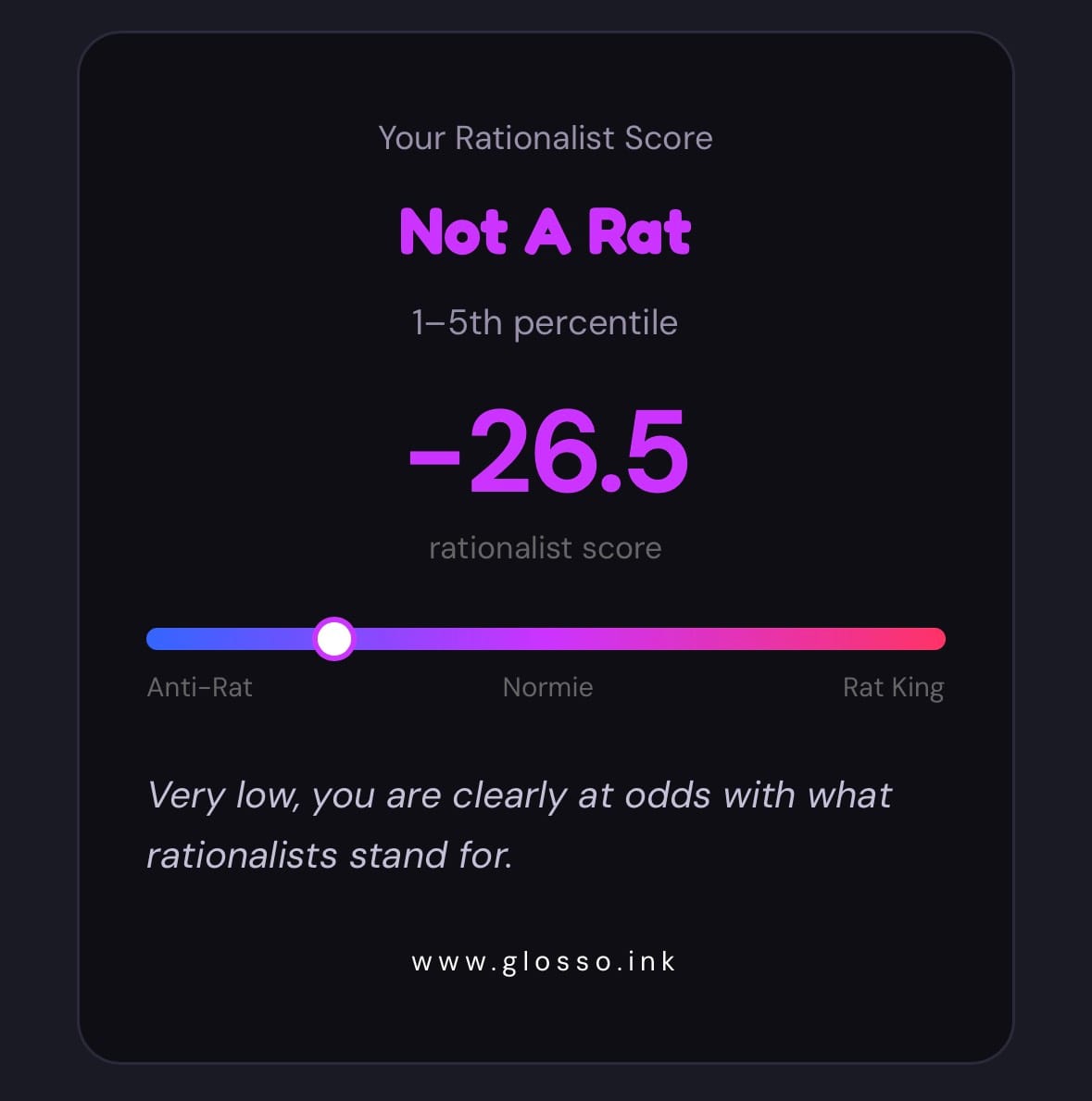
I was shocked by these results honestly. I thought I would get "normie" or "rat adjacent." After all, I am autistic; I try to be a rational person (look through my blog and you will frequently see the phrase "this is not rational" or "this is rational"); and I am strident about self-improvement and unlearning cognitive biases such as in-group/out-group bias. I write long blog posts about ethics that could easily be found on an Effective Altruist's Substack and my blog posts are full of hyperlinks to other blog posts. I consume content from >2 Rationalist content creators even when I'm not intentionally falling down a rabbit hole. I am generally opposed to how AI is being implemented in society under capitalism and the ways LLMs are eroding reality—but that does mean I believe AI is an important matter worth discussing at length. I'm not opposed to the concept of a neural network. I have read some essays by Eliezer Yudkowsky and did not disagree with them. During my rabbit hole, I read many blog posts that I thought were decently written and agreed with partially or in full. If I am to go off of how Tor Parsons describes Rationalists, then surely I would be "rat adjacent" (which he says is the most rationalist thing to be.)
So what makes me not just "not a rat" but "anti-rat?" In fact, in the bottom-most possible percentile of everyone in the entire world? The quiz does not reveal to me which questions determined I am "at odds with what Rationalists stand for." I think about all the questions about the superiority of people who are genetically predisposed to intelligence. Is that really a rational or evidence-based belief? Is that what the rats stand for? The majority of them? If you are one of my readers, I shouldn't need to argue against this. That is a fundamentally supremacist idea, and I am fundamentally opposed to supremacist beliefs. Is that what makes make "at odds with what rationalists stand for?"
The most recent blog post by Scott Alexander on his new Substack posits that humans might be better off abolishing democracy and relinquishing total control of the state to a super-intelligent AI—and that this may be possible by 2040. Twelve years ago he believed he was a member of the "blue tribe." I cannot imagine how a belief in relinquishing control of society to a corporate-created superior authoritarian dictator, human or not, is "blue tribe." It might be the most illiberal thing you can argue for. Not everyone needs to be a socialist, but I would hope the self-determination of humanity is a "reasonable idea we can all agree on."
It takes three clicks to get from Jeff the Effective Altruist's blog about folk music to Scott Alexander's call for the end of human self-determination.
The Greys are Among Us
Rationalists seem familiar to us because, if you run in the circles I've run in, then you know some of them. Maybe they hold off on talking about their beliefs to avoid conflict in a social context where they know it's unacceptable, but they are there. They are, after all, socially compatible with us, even though they are politically incompatible. We are cousins, in a sense. We like the same things. Naturally, we would meet.
I have a social dance friend who I have known for a number of years. He used to live around Boston but fled the country when the Trump administration decided not to renew his visa. We've chatted online a lot about shared interests. I like this man. I think he's a good person. He's never expressed right-wing political beliefs to me. He has a very distinct internet avatar. On Substack, it shows you who has liked a post. I saw his avatar at the bottom of a post. My friend had liked a Rationalist Substack post. I looked at his account. It's public who you subscribe to. He follows upwards of ninety rationalist blogs and blogs about AI. My friend this whole time had been a rationalist, or at least "rat adjacent."
I noticed an odd pattern. Rationalists seem to really like social dance for some reason. Cassie Nova mentions that SlutCon had social dance workshops. In the comments of Rationalist self-help essays, readers ask how to develop social skills, build confidence, and talk to women. Other rats would all reply: get into social dance. There's a rational argument for why social dance is good for socially awkward autistic men who want to be less awkward.
Rationalists are nearly as concerned with "mating" as they are with AI. Many Rationalist essays are about reverse-engineering social skills and hacking your brain into developing charisma. There are some peculiar social techniques that would stand out to me, and then I would realize, oh, doesn't my friend's partner act like that? And didn't they talk to me at length about AI that one time? I found myself getting paranoid as I flipped through my social Rolodex in my mind. How many crypto-rats are there in my extended network? Do they all believe in the superiority of people genetically predisposed to intelligence? Do they want to replace democracy with Claude? Are they tithing 81% of their income to MIRI?
But of all the people I identified as "probably at least rat-adjacent" I couldn't identify one who I think is a bad person, or feel unsafe around. Maybe that's because of their charisma hacking skills. Maybe I'm falling for their trick. I like every rat I've met.
I remembered an ex-boyfriend who seven months into dating revealed he believed in replacing democracy in its entirety with a single direct instant vote mediated by technology on how high or low property taxes should be, and a law that if you pay someone else's property taxes you can buy their property by force. This somehow was meant to solve all of our problems. He said "half the economy should be controlled by intelligent people like Elon Musk." I sent him a PhilosophyTube video essay on Elon Musk. He said he didn't want to watch it. We broke up weeks later. Of all my exes, he's always been the one I couldn't get over. He had seemed so perfect to me, until he revealed his bizarre beliefs. How many of these "OK rats" I know are like that? Waiting to reveal something dark?
The most fundamental incompatibility between them and us, the reason we have two tribes that only overlap a little, is the belief in disassociating from people with strong enough differences of opinion. We don't all agree with each other, and the rats don't all agree with each other, but the rats don't distance themselves from people they disagree with. They will platform a right-winger's Substack post if they agree with that one post even if they disagree with the rest of the blog. They will do the same for the left. On our side, we criticize each other for reblogging from people who follow people who follow people who reblog unacceptable positions.
On the left we have an axiom: "if there is one Nazi in your bar, it's a Nazi bar." By this logic, the Rationalist movement is a Nazi bar. The rats have their own axioms (whether or not they will admit they are axioms) which lead them to think it's irrational to leave a bar with good drinks and company just because one person there is a Nazi.
This axiom originates from our anti-fascist praxis that treats fascist ideology like a virus. However, we tend to extend this practice to all problematic ideas and behaviors—becoming a sort of moral contagion. Because we on the left disassociate quickly from people we disagree with enough or who associate with people we disagree with, we distance ourselves from the rats, and we stop exposing them to our ideas. It's clear when you see rats attempting to summarize left-wing positions that they don't quite understand our viewpoint. They haven't talked to us at length or engaged at length with our texts. Aella's weird ideas around consent only make sense if Aella and I have never spoken and she has never read even a brochure from Planned Parenthood about FRIES.
But the Right does not distance themselves from the rats. The grey tribe, once self-identified as a subset of the blue tribe, now spends more time talking to the red tribe and being exposed to ideas like "sex differences are rational" and "some people are just more worthy of power than others." After all, the tripartite Atheist schism began over disagreements about Feminism.
The left-wing habit of distancing ourselves from rabbit holes that lead into fascism is not outright stupid. It only took three clicks from a benign effective altruist blog about folk music to get to calls for the abolition of democracy. There is an element of real danger in "rat world." There is a strong presence of patriarchy. There are messed up ideas around consent. There are fascists. If you use the right in-group axioms and familiar arguments, you can easily build trust and convince people that dangerous ideas are "rational" when they simply are not. Genetic predisposition to General Intelligence is not an objective rational evidence-based belief. It is socially motivated.
The whole point of Rationalism was to unlearn the sorts of cognitive fallacies that lead to things like agreeing with an in-group because they are your in-group, but nobody is immune. Our brains are fallible. Reading "the Sequences" I very much felt as though I was reading an English translation of the Tao Te Ching. It is a religious text and it is formatted and presented as one. "Aspiring to Rationality" is but another term for seeking enlightenment. They rid themselves of biases instead of attachments, but they do not truly become unbiased any more than the average Buddhist truly ceases to desire. The Sequences are long. As you read any long text you begin to absorb the thinking of the author. A sociocognitive architecture is built. The early chapters made some sense to me, but it would take me a very long time to get to the end. I wondered what ideas would seem to "make sense" by the end, if I ever got there, which I would find absurd now. I've been around cults and new religions plenty to know I am not immune.
I could see myself in Eliezer Yudkowsky. I too am a Jewish autistic autodidact who overthinks everything and re-invents pre-existing concepts from first principles. The idea of thinking myself into thinking better has appeal. Yet, I've studied psychology and cognitive science enough to know that material reality and pure logical consciousness are fleeting effervescent things. The Rationalists are no more immune to good rhetoric and in-group affinity than anyone else. We certainly know they are no more immune to cult-think than anyone else. The Zizzians believed they were making themselves more rational. Ideas that seem absurd to most people become plausible when you surround yourself with people who share and reinforce those ideas, especially if going back on your views could cost you your entire community.
The appearance of rationality can make the absurd seem reasonable. In one blog post, a prominent rationalist described a nightly ritual he and his wife participate in. Every night they each state on a scale from one to ten how horny they are and how sleepy they are. Then, they add their scores together and if the cumulative horny score is large than the cumulative sleepy score they have sex—and if the cumulative sleepy score is larger than the cumulative horny score, they go to sleep. I had otherwise been enjoying the writing of this author, but this system of his is simply performative rationality. I couldn't help but laugh. It's nonsense. Either party can say whatever they want. If you don't want to have sex you can say 10/10 sleepy and 0/0 horny. If you want to have sex you can say 10/10 horny and 0/10 sleepy. The only way to counteract that move is to do the same and cause a draw, and then what happens? The winner of this system is simply whoever is more willing to state a bigger number. It is not meaningfully different from saying "I want to have sex" and "I want to go to sleep." The author seems to partly realize this, as he then describes how he began "down-regulating his preferences" by dishonestly giving smaller numbers. This way, his wife would get her way more often. Is this rational, or merely the appearance of rational? When you remove the ritual, then this is simply a man guilt tripping his wife into having sex by saying his desire for sex outweighs her desire for sleep, and then later realizing he should stop doing that.
He tells this story to illustrate how he is so devoted to his wife's wants and needs, that he simulates her in his mind so clearly and has cognitively trained himself to always act according to her desires above his own, that "consent becomes unnecessary, because I would only do the things I know she wants. We just know each other that well." I found myself nodding along thinking yeah that makes sense. He had gained my trust, built rapport, with the earlier essays I had read. He seemed like a reasonable guy. Then I paused and thought about it again. No it doesn't. Your mental simulation of your wife cannot stand in for the actual will and agency of your actual wife. You could think she wants something when she really doesn't and you can't actually read her mind. Consent is an act of communication, not a state of desire. If the government dug up your front lawn and planted a beautiful garden of native plants overnight that perfectly matched your aesthetic preferences and then paid you $500, it may be something you would have agreed to, but they didn't ask. They didn't get your consent. The shock and surprise of it all would elicit different emotions than if you had been asked for consent.
Maybe the high-SMV high-IQ rat wife feels differently, but isn't the whole point of this stuff to show each other we care? I try to imagine how I would feel if I told my hypothetical rat-husband that I was 7/10 sleepy and 2/10 horny and he told me that he was 3/10 sleepy and 8/10 horny, and 11 > 9 so we have to have sex now even though I'm very sleepy and probably won't enjoy it. I would not feel cared about. Would I feel more cared about if he had said he's 6/10 horny and 3/10 sleepy and 9 > 8 so we can go to sleep? I guess this is just a matter of compatibility and human diversity. I would much rather just hear "if you're sleepy, let's go to sleep" and not be told exactly how bad the blue balls are that I'm inflicting by choosing sleep over sex. This is a system fundamentally devised to prioritize male needs couched in performative rationality. It's very un-Rational (distinct from irrational) of me to criticize this system in this way, rather than applying game theory and Bayesian probability. Would the pressure to appear Rational pressure me into accepting such a system? I know my own personality. I know that the pressure to appear radical/leftist has led me to accept some terrible things in the past. I would be the same as a rat. I am not a unique person in this world, in that way.
Take Hands Down the Line
What do you do when a member of your family starts to spend time at a bar with one Nazi? What do you do when your friend is in a relationship with a man who is friends with a man convinced of domestic abuse? What do you do when someone in your community joins a front-group for a cult? Tor says there are a lot of trans people who are rats. I didn't find any in my rabbit hole but maybe the trans rats just aren't blogging in the same blog-o-sphere. Trans people are few in number and highly vulnerable. The Zizzians were mostly transgender. I don't think the entire Rationalist religion is a cult—but like any new religious movement it is prone to cults emerging out of it. Early Christianity was weird too and modern Christianity is still quite prone to growing cults. Marxism produces plenty of cults too.
Perhaps eventually Effective Altruism or some other sect of Rationalism will stabilize into a safe non-cultish religion, like Quakerism or the United Church of Christ. Involvement with the UCC doesn't make me fear someone will become a Creationist homeschool, and involvement with the DSA doesn't make me fear someone will become a Neo-Trot selling newspapers forty hours a week. I don't yet feel this way about Effective Altruism. The movements are too closely knit together. As it stands, all involvement with Rationalism puts its members in uncomfortably close proximity to cults and fascists.
Much of my life has been spent trying to strike the balance between expanding who I am responsible for and unlearning codependent behaviors. I want to expand my empathy and care to include neighbors, coworkers, strangers, and people in my communities who I am not best friends with. I want to share genuine moments of connection with people different from me. I also must not see myself as the agent in someone else's life. I have to keep my hands off of other people's problems and maintain reasonable boundaries. I cannot take the correct actions and say the correct things to forcibly "deprogram" an AI-Doomer working for Anthropic.
Something Rationalists and I have in common is we love arguing. I had a college friend who was a sort-of proto-rat (this was before the blue-grey split.) Much of our friendship was arguing, and by the end of college; they said "I think I am a better person because of you." It's one of the compliments I hold dear to my heart. We were able to argue in good faith so much because we did so in the context of a shared community and shared friends. Early on, we had hated each other, but our friends kept putting us in the same room and we came to trust each other. I did not say all the correct things to forcibly change that friend's mind. We still disagree on many things. But we came to influence each other and created more comfortable ideological overlap.
In Psychology there is a known phenomenon called the "mere exposure effect." The more you see or encounter someone or something, the more affinity you grow for it. Mere exposure creates familiarity and builds trust. Our social bonds keep us together.
Humans are social creatures, and that is why arguing with rats about if they should be rats won't accomplish much. Just like someone in any religious community, or someone in a romantic relationship with someone, people want to maintain their social bonds above most other things. When you argue with a rat about their community, it does not matter how strong your argument, or how "rational" you're being, what you are arguing for is self-isolation.
Why should a rat listen to someone who is telling them to give up their entire community and what, be alone? Be the only weird autistic person like them? Being lonely is likely how they got into the community in the first place. Especially if you are being scolding or shaming, from an emotional place (and rats do have emotions) they lack any motivation to listen to you.
On the inverse, if you have a social bond and shared community with a rat, then preserving their social bond with you will become a biasing priority that de-escalates tension and inclines them to try to reach mutual understanding sufficient to stay on good terms. The "crypto-rats" aren't hiding their affinity for AI substacks, but choosing not to bring them up to maintain social harmony. People attenuate their stances when they realize there is disagreement in their community. This is a good and healthy human behavior.
To leave an abusive partner, one must have a support network they feel they can rely on in lieu of whatever support they got from their partner. To leave a community, someone must feel that there is another community who will accept and love them. Without each other, we have only the extremists who reinforce extreme beliefs and pull us towards the fringes. Together, we can form a community that is still there for you when you begin to be critical of your beliefs. If your primary community is exclusively Rationalists, you cannot question the shared beliefs and values that define your community. We want our communities to comfortably overlap, so that they are still in a community should they begin to distance themselves from Rationalism.
Allowing rats in our community spaces builds trust and rapport. If they ever discover they need to get out, they will feel safe doing so, because they know the gals at their Transgender Magic: The Gathering night will still be there. Mere exposure to each other breeds familiarity. Community isn't about liking everyone or being exactly like each other or agreeing on everything.
To use Contra Dance as a metaphor, yet again, when everyone dances together in the set, they can forget their differences for seven to ten minutes, and it can make hard moments easier down the line. When AI comes up at a contra dance, "AI should be banned and everyone who uses it is evil" attenuates to "I just don't think the way it's being developed and implemented in society is responsible or positive." Likewise, "humanity can turn over control of the state to a sufficiently superior AI by 2040" attenuates to "I think there is a lot of potential to be found in responsible development of AI technology." Our bonds pull each other away from extremes. When we say something out loud, we often realize that it is true. When we find common ground, we overlap ourselves together, and we connect.
But, building trust and rapport goes both ways. Exposing them to our beliefs will also expose us to their beliefs. Mutual trust means we will trust them, and might overlook red flags we otherwise would be concerned about.
After my deep dive into the rat's nest, I walked away with a new belief I had picked up. I began to think that all men want to be manipulated by women into thinking about us at all times. I began to flirt with a guy I like by intentionally manipulating him into thinking about me—by playing mind games. This did not last very long, fortunately. I described what I was doing to a friend, and as I spoke it aloud, realized that I was being a controlling person. As a strong devotee of Marsha Linehan (may her memory be a blessing), I reminded myself that I fundamentally cannot control other people. Mind games are a poor foundation for building a relationship of mutual trust and respect. I returned to my values and the healthier behaviors I am always trying to cultivate in myself. I value respecting agency, and playing mind games is not respectful of agency.
I reflected on when I had started to play these mind games, and it had been a week prior, after reading a Rationalist essay about how to "bewitch men." I gave the essay a second, more critical, read. I found within it many misogynistic patriarchal beliefs about female behavior and messages about ostensibly the importance of "putting out." The mere exposure to so many essays by this author had built enough trust that I accepted these ideas less critically than I would have if this was the first essay I had read. I recalled my rat-adjcaent ex-boyfriend who worshiped Elon Musk. Partway into our relationship, he had revealed to me that he mined crypto-currency. I was more willing to believe—in 2019—that this was an ethical and sensible things to do because I trusted him. I know, rationally, that I am biased to believe in someone I am dating when they reveal something I would normally condemn, but I am not a rational being. I am a social animal. In retrospect, it was a huge red flag. In the moment, to be critical of it was to prioritize an abstract harm over a tangible relationship. All humans, including rats, are biased to prioritize the tangible relationships.
To know and love each other is to allow ourselves to be changed and influenced by each other. Connection is a conduit for change. The risk of being influenced cannot be mitigated. You are not immune to being manipulated by Elizabeth Holmes. You are not immune to joining a cult. You are not immune to filter bubbles. You are not immune to being charmed into an abusive relationship. You are not immune to propaganda. We can choose to allow people we trust to change and influence us more, but we cannot choose to not be changed or influenced.
So if I am calling for including the grey tribe in our weird nerdy communities, to protect them from falling into fringe rat cults, then how do I propose to protect our communities from fringe rat cults and their dangerous ideas? We must look within to the dynamics of our own communities, and through building healthier community dynamics, we can build resilience against cults—theirs and ours.
Sarah Schulman writes in her solidly 3-star book Conflict is Not Abuse that at times entire social groups seem to develop a shared mental illness at a meta-communal level. I've written before about how social media can make OCD and BPD contagious. (Since that blog post, I've been properly diagnosed with OCD. Did I catch it from social media? Who can say). Many of us in the blue tribe believe we can exert control over who can influence us by treating bad ideas as a social contagion. We distance ourselves from those who do not distance themselves from things that are problematic. This is a sort of meta-OCD compulsion that easily becomes unhealthy to us as individuals, communities, and movements. When this compulsion is left unchecked, it becomes repulsive to our out-groups. It's what the benign grey-tribers like Tor cite for why they prefer the rats over the feminists.
Many of us participate in this compulsion because it is socially enforced, but the enforcement works because for too many people on the left, our beliefs and stances are entirely socially formed, and not derived by base principles. We repeat axioms and believe the beliefs of those we respect—out of deference, and not careful consideration. The Rationalists are not Rational, but they are correct to value argument and rationality. We can be less afraid of being changed if we are more mindful and conscious of when and how we change.
The toxic community dynamics in very online and left-associated communities is basically the primary topic of this blog. I was once delivered a stinging insult: I was called the female Eliezer Yudkowsky. Ouch! Well, call my blog LessToxic then, because I will never stop being verbose and intellectual. (Please do not form a new religious movement around my blog posts, though.)
My solutions here are the same things I've been writing about on this blog for years. You must learn to shift between reality tunnels and be aware of how your information sources shape your view of reality. You must learn critical thinking skills and develop information literacy. I am actually in agreement with Eliezer Yudkowsky: You should be more conscious of your biases. You should be engaging with ideas and forming beliefs not based on their social affiliation but based on your own independent morals and values.
I do not reject the notion of the superiority of the genetically intelligent or the prospects of an AI ruling humanity because they are the ideas of the Rationalists, whom I see as my opponent politically. I reject these ideas because they are incompatible with my integrity. I believe the world is a worse place when one group of people is treated as the natural ruling class. I have an architecture of ideas holding up that belief. I believe in the importance of agency and self-determination. I believe that absolute power corrupts absolutely and that no one person (or non-human entity) can be trusted to be perfectly competent even if they could be trusted to be perfectly benevolent. I have an architecture of ideas and experiences holding up these beliefs. I am "at odd with what Rationalists stand for" because of my rationally derived beliefs. I know how I've derived these beliefs and why I believe them. I know how to cite my sources. I am conscious of my information sources and biases. I am, in fact, practicing what Eliezer Yudkowsky preaches, but because I am a librarian, not because I am a rat. (We know I'm not a rat, because Aella's eugenics sex quiz said so.)
The risk of social contagion and cult-think is diminished when our beliefs are less socially determined. We must not fall into the LessWrong pit-trap and believe we can completely unlearn our biases and become immune to irrationality. We will always be shaped by the people around us. However, knowing what your core values and beliefs are can be something you can check-in with when engaging with new ideas. Encouraging others in your community spaces to have a stronger sense of why i.e. Feminism is Good can inoculate against the social influence of the rat's nest. I caught myself internalizing the misogynistic belief about feminine mind games because, when I spoke it aloud, I noticed how it conflicted with my core value of respecting agency. My religion, Judaism, helps hold me to a certain moral code. Atheists do not need a religion to serve this purpose for them, if they are intentional and conscious about forming their own system of beliefs and values. I am, once again, asking you to read Chris Stedman. (I am going to grab an ARC of that new 2027 book when I can, so help me. In the meantime, read IRL.).
You may find that when you discuss your core beliefs and values with other Leftists, that you disagree far more than you realize. This is okay. Disagreement is not a bad thing. I value social harmony, but many of my friends do not. This is great practice for being comfortable with difference. Have fun with it.
When I reconnected with my mother, I was shocked by how many little things we inexplicably had in common. She carried a handkerchief to blow her nose all day. She inflected her voice the same. We were irrefutably related in millions of tiny intricate ways. When the fire-spinning furry and the contra dancing effective altruist meet, they are much the same.
The grey tribe are our estranged cousins. At some point, after we split, they ended up forming a new religion that spins off fringe cults left and right. They have odd and unhealthy community dynamics, and platform dangerous ideas. Chris Stedman correctly highlights how the very-online-left can also, at times, function as a religion, and spin-off our own fringe cults. We have our own unhealthy community dynamics and, dare I say it, sometimes we platform some stupid or dangerous ideas (for instance, ballot spoiling during the 2024 election.) We are, after all, the cousins of the rats. We are familiar. We are of the same genus—possibly even the same species. We are the internet-greebled weird autistic nerds.
My big 2026 theme has been ending estrangements, and I suppose I am saying we might consider working to reconcile the blue-grey estrangement. I pulled my estranged mother away from the MAHA cult, maybe we can save some rats from becoming Neo-Zizzians. I am not proposing that the entire autistic blue tribe re-marry the entire autistic grey tribe. I am interested in being friends with Jeff, Tor, and Cassie. I am not interested in being friends with "Walt Right" or 2026's Anti-Democracy Scott Alexander. Aella and Eliezer are maybe's. Let me pick a buddy and lock the four of us in a three-week debate-filled slumber party. We'll see what happens.
You do not reconcile a relationship by asserting that you are 100% right and the other person is 100% wrong and they have to do all the work to come to your side of things. Tor's plea to "come back" doesn't work after he just spent a few minutes bad-mouthing the "second internet ideology." A similar plea from our side would be similarly ineffective. We cannot just assert that the blue tribe Autistics are better and the rats should just abandon everything they like about being rats, drop their entire worldview, dye their hair blue, and become one of us. Why would they even want to do that? They have their own community that is thriving and gaining more political and economic power every day. They believe they are building a god. Why would they abandon that just because we say they should?
The rat's nest as an abstract subculture isn't something we can directly tackle. I am not really proposing we do anything about that. Rather, I am thinking about the dynamics we create in our communities, and about individual "rat-adjacent" people you may encounter. I am thinking about our propensity to treat rats as carrying a contagion. I am thinking about our nasty habit of asserting certain spaces as "our territory" and not allowing filthy problematic things into "our spaces." We need not be wild animals pissing all over telephone poles to claim them.
I am thinking about our obnoxious propensity to tell everyone that touching AI with a ten-foot pole makes you an ecocidaire. It makes it difficult to genuinely engage in earnest conversation with people who aren't already convinced of our positions. I think there is value in just being nicer to people. I am staunchly anti-AI, but of all the people I've convinced to stop using AI, I never got there by yelling at them. In fact, I often got there by being nice and taking their side when someone else was yelling at then. It built the trust necessary for them to later hear my position.
Let's make our community spaces into nice places people want to be in, with healthier community dynamics, that are welcoming of imperfect people. Let's befriend people and create spaces of comfortable overlap. Let's build rapport and have earnest two-way conversations about our core values and morals. Existing in spaces of comfortable overlap together will naturally influence all of us together towards each other and away from extremes.
There is no reason for fire-spinning, contra dancing, fursuiting, juggling, dungeon monitoring, LARPing, Magic (the) Gathering, or any other niche hobby to be the exclusive domain of the blue tribe. I think it's great that our values are dominant in these spaces, but it's healthy for us to be welcoming. You don't have to let the Nazi into the bar, but we should be happy to see your sister at the family barbecue whose boyfriend goes to a bar with one Nazi at it. It's better to be seeing her here than there.
Adventurer League Night at your Friendly Local Game Shop is like our version of the family barbecue. It's better for our rat-cousin to be making friends over D&D offline than making friends at LessOnline. If she brings up reading Sasha's Blog or LessWrong, just be chill and don't treat her as ontologically evil or contaminated. Befriend her. Be a good community member. Build trust and rapport. Eventually, if or when your disagreements become apparent, you will have the shared social bonds necessary to have a healthy conversation about it. Be open-minded enough to genuinely engage in a pro-social way. Who knows, maybe you're wrong about something, and you could be (heh) less wrong about it. Check in with your core values if you're unsure. Be open to the possibility that you can't change them, but you can still share space anyway. You fundamentally cannot control other people, but you can still share connection with them.
Importantly, don't make it feel like the outcome of a conversation will make or break the friendship. People become braced and guarded when they feel attacked, or like they are arguing for their continued inclusion in a community. Very often, arguments that on the surface seem to be about politics or AI, are psychologically arguments over who gets to remain in the community. Don't make them feel like they're arguing for "I'm a good person." Try using phrases like: "I value you as a friend, and this isn't going to change that, I just want to understand" or "I am committed to staying in community with you, but I want to work through this tension between us."
Like much of what is written for an Autistic audience, I am sure much of this blog post reads to some as "this is all obvious, you just have OCD" or "only Kindergartners have to be taught this stuff" but I have learned that it never hurts to re-state what's "obvious" for those of us in the room, like myself and Eliezer Yudkowsky, who are Autistic autodidacts who never went to normal school and have to re-invent everything from base principles. I am all-too-aware that some of my readers have horrendous social skills and deeply benefit from reading stuff like "try being nice to people." I have many times needed to be told myself in so-many-ways that I should try being nice to people.
I doubt I'm going to convince Jeff to stop giving 81% of his income to AI-focused organizations. I've never even met the guy. I think it is beneficial of me to stay in community with him anyway. I think there is something fundamentally healthier about blue-grey (bleige?) overlap. Just a little bit of overlap, as a salve. I think it is good for me to dance with the young Autistic girl at my local contra who told me "AI-generated fliers are only ugly because people don't know how to prompt them correctly." I disagree with her and I think she's wrong and I still hate AI-generated fliers. I think keeping her in the same boat as me is healthy for both of us. Maybe she will come around to my side, and maybe she won't, but so long as she has shared community with me at Contra, she is much safer from ending up in the hands of the darker corners of Rationalism, and I am much safer from ending up practicing with rifles in the Florida Everglades. That's all I'm calling for really. Just that.
The reason I think this is good is ultimately because I care about her. I don't know her all that well, but I do care about her. She's in my community. She's Autistic. She's weird. She's my people. We're familiar. I don't want her ending up in a "group home" in Berkley. I don't need her to be a Communist. Maybe she'll always be one of the other autists, in the other tribe. Still, I want her to be safe from the sexual abuses of the Silicon Valley. That is sufficient for me to be content that I have done enough. There's only so many people like me in this world, after all.
P.S. A Reminder About Social Boundaries
Lately, my hobby has been something that happens at particular offline synchronous events. It's not very good OpSec of me to discuss this hobby, since it's not a very big community. I do think everyone should try Contra, but if you do try it, then yes, it's likely you'll encounter me offline at some point, depending on your geography.
I just want to mention that Shel Raphen is not my real name. It's an internet pseudonym I write under to separate my offline life from my online writings. It's easier to write about rather personal things when it's under a pseudonym. Sometimes, I've shown up to certain events, like the Cohost Memorial, using my pseudonym, but in general, in the offline world, I am not telling people that I am Shel Raphen or about my blog, or Cohost, or Mastodon.
I very much do not want to be micro-famous anymore. I enjoy having my blog, with only 80 subscribers, and do not want to return to being a Twitter power-user with 3,500 followers. In my offline life, I am trying to just be a regular person like anyone else in any offline space. I don't want to have fans with parasocial relationships to me.
If you meet me offline, it's fine to acknowledge that you know who I am, but please remember that I am (probably) a stranger to you. Please do not tell random people I am talking to about my internet history or what my internet screen name is. It's an invasion of my privacy. Especially do not corner me physically, ask me where I live, and/or follow me when I try to leave the conversation.
Here is my recommended social script:
You: Excuse me, but are you Shel Raphen?
Me: Oh, yes, I am.
You: I really liked your essay about Rationalists. I found it to be nuanced and astute.
Me: Oh, why, thank you. That's very sweet of you.
You: It was nice to meet you. I'll let you get back to your conversation now.
Me: It was nice meeting you too. Goodbye.
It's insane of me to have a blog where I regular write rambling 10,000 word essays about being nice to AI-cultists. I don't need everyone in my offline life to know about it without my choosing to share.
Thank you for respecting my boundaries going forward.